
Saturday, March 21, 2009


Saturday, January 31, 2009


Saturday, December 27, 2008
NEW YEAR CELEBRATION.

Every time there is a celebration, it has become common to see people lighting crackers or fireworks. If you are one of those who enjoy watching colorful fireworks display or just about anything that has got to do with fireworks, you may like this device.
In fact it would help you from not getting your hand blown off while bursting crackers. The Launch Kontrol remote firework launcher can be used to detonate these fireworks and crackers and people can go ahead and have fun in relative safety. The remote works even at the distance of up to 75 feet.
One can launch up to 5 fireworks at a time and the remote system, which has 15 ‘e-clip’ igniters, costs $35 and an extra packet of 15 clips costs you $17. Looks like this festival season a lot of fireworks can be seen being lit.
Sunday, November 30, 2008


Wednesday, October 29, 2008

Friday, September 26, 2008
How EL Lights work ?


Electroluminescent (EL) devices are actually lamps. They emit light, but they are unlike any traditional lamp. Instead of creating light by heating a filament - as in an incandescent light bulb - or by charging a gas field - as in a fluorescent or neon tube, EL relies on phosphorescent materials which glow when exposed to a small electrical current. El lamps are cool, low power and emit a soft light without any irritating glare. They are invariably very thin, almost like ribbons or sheets of paper, and they can be produced in a variety of colors. The source of light is a phosphorous mixture which is spread onto a transparent, conductive ITO (indium tin oxide) film and then covered with another thin sheet of conductive material.
The color produced by an EL panel can be altered by changing the frequency of the voltage supplied to it and/or the amplitude of the voltage. It all depends on who manufactured the panel, its size and the type of inverter
Friday, August 29, 2008
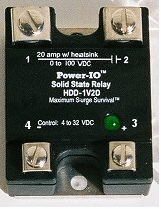
The Solid state Relay


One of the main disadvantages of an Electromechanical Relay (EMR) is that it is a "mechanical device", that is it has moving parts. Over a period of time these parts will fail, or that the contact resistance through the constant arcing and errosion may make the relay unusable and it will therefore need to be replaced. Also, they are electrically noisey with the contacts suffering from contact bounce which may affect any electronic circuits to which they are connected. There is another type of relay called a Solid State Relay or (SSR) for short which is a solid state contactless, pure electronic relay. It has no moving parts with the contacts being replaced by transistors, thyristors or triacs. The electrical seperation between the input control signal and the output load voltage is accomplished with the aid of an optocoupler type light sensor.
The Solid State Relay provides a high degree of reliability, long life and reduced electromagnetic interference (EMI), (no arcing contacts or magnetic fields), together with a much faster response, as compared to the conventional electromechanical relay. Also the input control power requirements of the solid state relay are generally low enough to make them compatable with most IC logic families without the need for additional buffers, drivers or amplifiers. However, being a semiconducor device they must be mounted onto suitable heatsinks to prevent the output switching semiconductor device from over heating.
The AC type Solid State Relay turns "ON" at the zero crossing point of the AC sinusoidal waveform, prevents high inrush currents when switching inductive or capacitive loads while the inherent turn "OFF" feature of thyristors and triacs provides an improvement over the arcing contacts of the electromechanical relays. Like EMR's an RC (Resistor-Capacitor) snubber network is generally required across the output terminals of the SSR to protect the semiconductor output switching device from noise and voltage transient spikes when used to switch highly inductive or capacitive loads and in most modern SSR's this RC snubber network is built as standard into the relay itself. Non-zero detection switching (instant "ON") type SSR's are also available for phase controlled applications such as the dimming or fading of lights at concerts, shows, disco lighting etc, or for motor speed control type applications.
As the output switching device of a solid state relay is a semiconductor device (Transistor for DC switching applications, or a Triac/Thyristor combination for AC switching), the voltage drop across the output terminals of an SSR when "ON" is much higher than that of the electromechanical relay, typically 1.5 - 2.0 volts. If switching large currents for long periods of time an additional heat sink will be required.
Input/Output Interface Modules.
Input/Output Interface Modules (I/O Modules) are another type of solid state relay designed specifically to interface computers, microcontrollers or PIC's to "real world" loads and switches. There are four basic types of I/O modules available, AC or DC Input voltage to TTL or CMOS logic level output, and TTL or CMOS logic input to an AC or DC Output voltage with each module containing all the necessary circuitry to provide a complete interface and isolation within one small device. They are available as individual solid state modules or intergrated into 4, 8 or 16 channel devices.
The main disadvantages of solid state relays (SSR's) compared to that of an electromechanical relay (EMR) are higher costs, only Single Pole Single Throw (SPST) types available, "OFF"-State leakage currents flow through the switching device, high "ON"-State voltage drop and power dissipation resulting in additional heatsinking requirements. Also they can not switch very small load currents or high high frequency signals such as audio or video signals.
Subscribe to:
Posts (Atom)


.gif)


